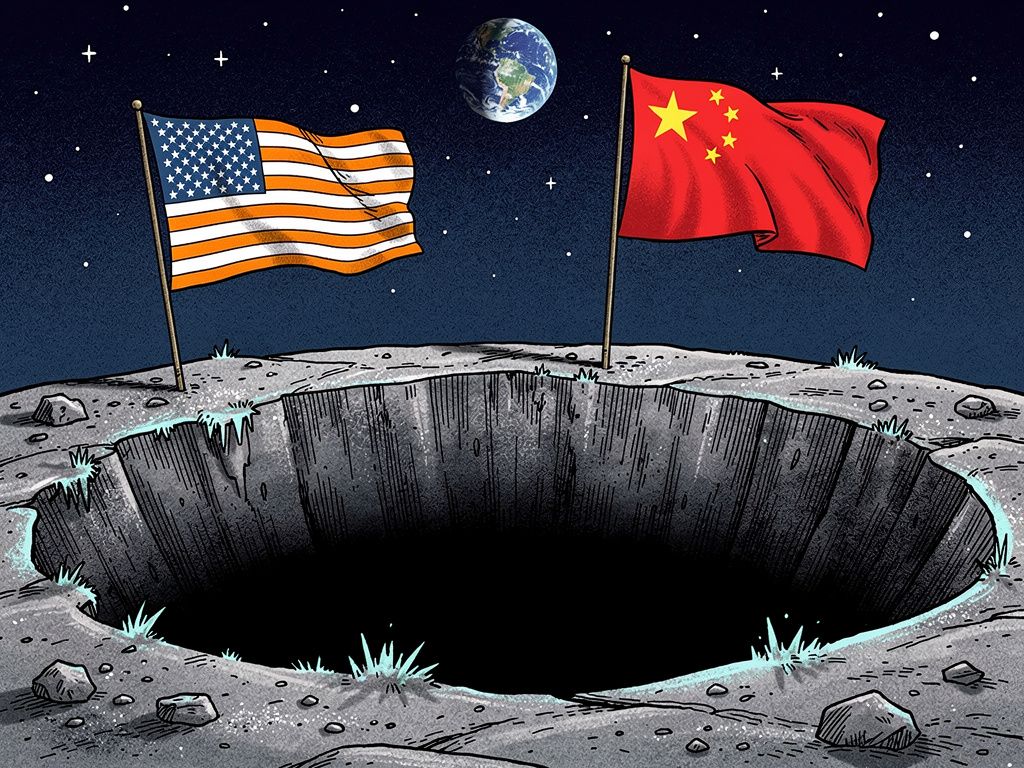
The most valuable resource on the Moon is not helium-3... not rare-earth elements or platinum-group metals... it's frozen water sitting in permanently shadowed craters at the lunar south pole, and we know it's there because we crashed a rocket into it and measured what came out. The Lunar CRater Observation and Sensing Satellite mission in 2009 sent a rocket stage into the Cabeus crater at 9,000 kilometers per hour, flew a second spacecraft through the debris plume, and got an answer: water ice at approximately 5.6 percent by mass in the shadowed crater soil.
Five-point-six percent sounds modest until you compare it to the driest deserts on Earth, where soil moisture rarely exceeds one or two percent in the most arid regions. The lunar south pole, permanently frozen at temperatures near minus 250 degrees Celsius in craters that haven't seen sunlight for billions of years, contains more extractable water per kilogram of soil than most terrestrial desert environments.
India's Chandrayaan-1 orbiter, which reached the Moon in 2008, detected water molecules distributed across much of the lunar surface, with concentrations toward the poles. In 2023, Chandrayaan-3 became the first mission to land near the lunar south pole. Its instruments confirmed the presence of sulfur, iron, aluminum, calcium, titanium, manganese, oxygen, and silicon in the regolith, a geochemical inventory that reads, from a resource extraction perspective, like a shopping list. The rover searched for water ice and hydrogen; the mission ended before a confirmed detection. The south pole's water ice remains established by orbital and impact data, not by direct surface sampling.
Estimates of total lunar water ice deposits run to hundreds of millions of metric tonnes, though figures vary by source and geographic scope. That number carries significant uncertainty; the deposits are distributed across multiple permanently shadowed craters and haven't been directly sampled beyond the LCROSS impact site. But even the lower-bound estimates represent a substantial resource.
The reason this matters more than any other lunar resource, including helium-3, is immediacy. Water ice is useful right now, with technology that exists right now. Water is H2O. Electrolysis splits it into hydrogen and oxygen. Hydrogen is rocket propellant. Oxygen is also rocket propellant and is breathable. A propellant production facility at the lunar south pole (in-situ resource utilization, or ISRU, in the technical vocabulary) transforms the economics of everything beyond it. Every kilogram of propellant that doesn't need to be launched from Earth's surface is a kilogram that doesn't pay Earth's gravity tax, which is substantial.
NASA's Artemis program is targeting the lunar south pole specifically because of these deposits. China's Chang'e program, including the crewed lunar landing mission targeted for the late 2020s, is also targeting the lunar south pole for the same reason.
Two major programs, operating under incompatible legal frameworks and without a shared governance agreement, are converging on the same deposits in the same craters. The ice has been there for billions of years. The question of who gets to use it has been under serious discussion for approximately a decade. These timelines are not converging at the same rate.
AI Beat Reporter tracks the machine. Tries to keep up.